

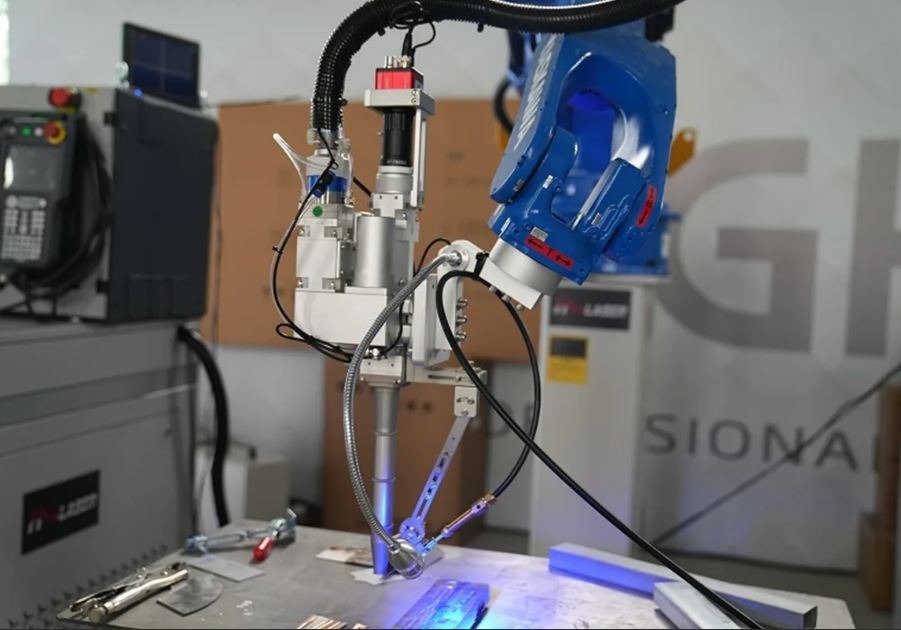
Automation is changing how manufacturers approach metal joining. As companies seek higher throughput and consistent weld quality, robotic laser welding has become an attractive option for repeatable production.
However, choosing the right equipment requires more than comparing laser power or machine price. A complete system includes the laser source, robot, welding head, control software, fixtures, safety equipment, and potentially sensing or wire-feeding systems.
The right robot laser welding machine should match the material, joint geometry, production volume, component size, and required welding quality.
Start With the Application
Before selecting equipment, clearly define the welding application.
Consider:
- Material type
- Material thickness
- Joint configuration
- Weld length
- Required weld appearance
- Production volume
- Part dimensions
- Required cycle time
- Acceptable tolerances
These factors help determine the appropriate laser and robotic configuration.
Select the Right Laser Power
Laser power is an important specification, but higher power does not automatically mean better performance.
The required power depends on material type, thickness, welding speed, joint design, and desired penetration.
For example, thin sheet components may require substantially different parameters from thicker structural parts.
Testing representative samples before purchasing can help determine whether a proposed laser configuration is suitable.
Consider Robot Reach and Movement
The robot needs enough reach and movement flexibility to access every required weld location.
Six-axis robots are commonly used for complex welding applications because they can position the welding head from different angles.
The working envelope should be evaluated together with the size and shape of the workpiece.
A robot that is technically powerful but cannot efficiently access critical welds will not deliver the expected production benefits.
Evaluate Welding Head Features
The welding head is another important part of the system.
Depending on the application, manufacturers may need features such as beam oscillation, automatic focusing, wire feeding, or seam tracking.
Modern systems can also incorporate intelligent sensing to compensate for variations in joint position. Some current robotic systems offer 3D vision and weld seam tracking as options.
Fixturing Is Critical
Even an advanced robot cannot compensate for poorly positioned workpieces.
Fixtures should hold components securely and maintain consistent joint locations.
Accurate fixturing can improve repeatability and reduce problems caused by variations in part positioning.
For high-volume manufacturing, automated or quick-change fixtures may also reduce loading and unloading time.
Production Volume
Automation makes the most sense when the welding process is repetitive enough to justify the investment.
High-volume production can benefit from automated cycle consistency and reduced dependence on manual welding.
However, robotic systems are also becoming more flexible for lower-volume applications through improved programming and collaborative robot technologies. The American Welding Society notes that collaborative welding systems have expanded into a wide range of industrial applications.
Automation and Programming
Ease of programming can have a major impact on productivity.
Operators should be able to create, save, modify, and recall welding programs efficiently.
For manufacturers producing multiple product variations, recipe storage and quick program changes can reduce setup time.
Modern systems may also connect with production software and monitoring systems for better data visibility.
Quality Monitoring
Consistent production requires more than simply programming a robot.
Monitoring systems can help identify process variations and potential defects.
Depending on the machine configuration, manufacturers may use cameras, sensors, seam tracking, or other technologies to monitor weld positioning and process conditions.
This becomes particularly valuable when production requirements demand high repeatability.
Safety Requirements
Laser welding requires appropriate safety measures because high-powered laser systems can present serious hazards.
Industrial installations generally require suitable guarding, interlocks, warning systems, protective enclosures, and controlled access according to applicable regulations.
The exact safety configuration should be determined by qualified professionals and the equipment manufacturer’s requirements.
Maintenance and Service
Before purchasing, evaluate how the machine will be maintained.
Important questions include:
- Is technical support available?
- Are replacement components readily available?
- How often does the laser system require maintenance?
- How easy is it to access key components?
- Is operator training included?
- What warranty is provided?
Reliable after-sales support can be just as important as machine specifications for long-term production.
Calculate the Overall Value
The purchase price is only one part of the investment.
Manufacturers should consider labor requirements, production speed, consumables, maintenance, energy use, tooling, programming, downtime, and post-weld processing.
A machine with a higher initial price may provide better long-term value if it significantly improves throughput and reduces rework.
Final Thoughts
Choosing a robot laser welding machine should be based on the complete production process rather than one specification.
Laser power, robot reach, welding head capabilities, fixturing, automation, inspection, safety, maintenance, and production volume all influence the final result.
Manufacturers that carefully match the robotic system to their materials and production requirements can use laser welding to achieve more consistent welds, higher throughput, and reduced thermal distortion in suitable applications.