

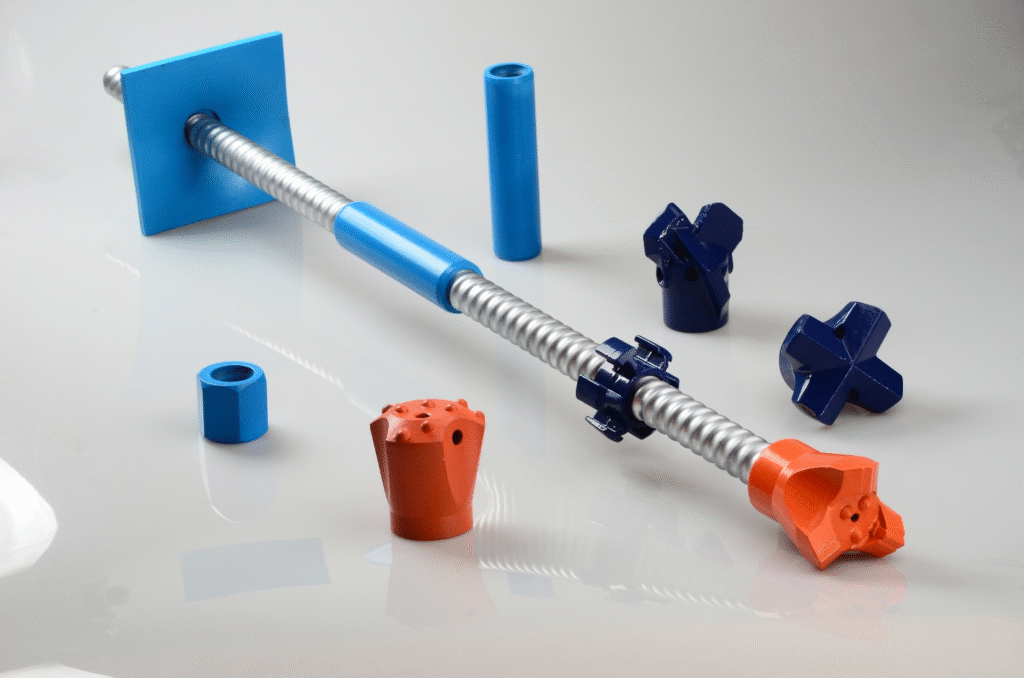
Slope instability is a common challenge in construction, mining, road development, and infrastructure projects. Heavy rainfall, erosion, weak soil, fractured rock, and excavation can all increase the risk of landslides and ground movement. To address these challenges, engineers use different ground reinforcement methods, including self-drilling anchoring systems.
A hollow anchor bar is one such solution that combines drilling and anchoring into a single system. It can be particularly useful in difficult ground conditions where conventional drilling and grouting methods may be challenging.
What Is a Hollow Anchor Bar?
A hollow anchor bar is a steel anchoring component with a hollow center that allows drilling fluid or grout to pass through the bar during installation. Unlike traditional solid anchor systems, hollow bars can serve as both the drilling element and permanent reinforcement.
The system is commonly used with a sacrificial drill bit. Once the bar reaches the required depth, grout is pumped through its hollow core. The grout fills the surrounding space and helps create a strong connection between the anchor and the surrounding ground.
This approach can simplify installation while providing reinforcement in unstable soil and rock formations.
How Does It Help Stabilize Slopes?
Slope stabilization aims to prevent soil or rock masses from moving downhill. Anchoring systems improve stability by transferring loads from potentially unstable ground into stronger layers beneath or behind the slope.
A hollow anchor bar can be installed at an angle through the unstable section of a slope. After drilling, grout is injected through the bar, creating a bond between the steel reinforcement and surrounding ground.
Depending on the project design, anchors can work together with bearing plates, nuts, mesh, shotcrete, or other slope protection systems. This creates a reinforced structure capable of resisting movement and improving overall slope stability.
Key Benefits of Hollow Anchor Bars for Slope Stabilization
1. Efficient Installation
One of the main advantages is that drilling and anchoring can be completed as part of the same installation process. This can reduce the need for separate drilling and casing operations, especially on projects involving difficult ground.
The hollow design also allows grout to be delivered through the center of the bar, helping simplify the installation process.
2. Suitable for Difficult Ground Conditions
Slopes often contain loose soil, fractured rock, voids, and mixed geological formations. Maintaining an open borehole can be difficult in these conditions.
Self-drilling hollow anchor systems can be useful because the bar remains in the ground after drilling and becomes part of the reinforcement system. This can make them suitable for applications where conventional drilling methods may face instability.
3. Improved Ground Reinforcement
Once grout surrounds the anchor, it creates a bonded system between the steel bar and the surrounding ground. The resulting reinforcement can help transfer loads into more stable ground formations.
Engineers can select different bar sizes, grades, thread configurations, and drill bits according to ground conditions and project requirements.
4. Corrosion Protection
For permanent slope stabilization projects, corrosion resistance is an important consideration. Galvanized hollow anchor bars can provide additional protection against environmental exposure compared with untreated steel.
The appropriate corrosion protection should always be selected according to soil conditions, groundwater, project lifespan, and applicable engineering standards.
Common Applications in Slope Engineering
Hollow anchor systems can be used in several types of slope stabilization projects. Common applications include:
- Highway and railway cut slopes
- Excavation support
- Landslide stabilization
- Rockfall protection systems
- Retaining structures
- Foundation reinforcement
- Mining and quarry slopes
- Temporary and permanent ground support
They may also be combined with shotcrete and steel mesh where surface protection is required.
Choosing the Right Hollow Anchor Bar
Selecting an anchoring system should be based on the site’s geological and environmental conditions rather than simply choosing the largest or strongest bar.
Important factors include anchor diameter, steel grade, thread type, drilling depth, grout properties, expected loads, groundwater conditions, and corrosion requirements. The drill bit should also be appropriate for the type of soil or rock being drilled.
For projects requiring corrosion-resistant reinforcement, galvanized options can be considered. You can explore a galvanized hollow anchor bar designed for self-drilling applications.
Final Thoughts
Slope stabilization requires a carefully designed combination of reinforcement, drainage, surface protection, and ground engineering techniques. A hollow anchor bar can provide an efficient anchoring solution by combining drilling, reinforcement, and grouting within one system.
Its ability to work in challenging ground conditions, simplify installation, and provide reliable reinforcement makes it a valuable option for slope stabilization projects. However, the correct anchor specifications and installation method should always be determined by qualified engineers based on the site’s geological conditions and project requirements.