

Epoxy flooring is available in different forms, and two systems may look similar while providing different visual and functional characteristics.
Traditional epoxy flooring generally focuses on creating a smooth resin surface, while colored sand systems incorporate decorative aggregate into the floor structure.
Understanding the differences can help property owners choose a system that matches their environment.
What Is Traditional Epoxy Flooring?
Traditional epoxy flooring typically consists of resin and hardener components that are mixed and applied to a properly prepared concrete surface.
After curing, the system forms a bonded coating over the substrate.
Depending on the formulation, traditional epoxy can provide a smooth, glossy, or satin finish.
What Is Colored Sand Epoxy Flooring?
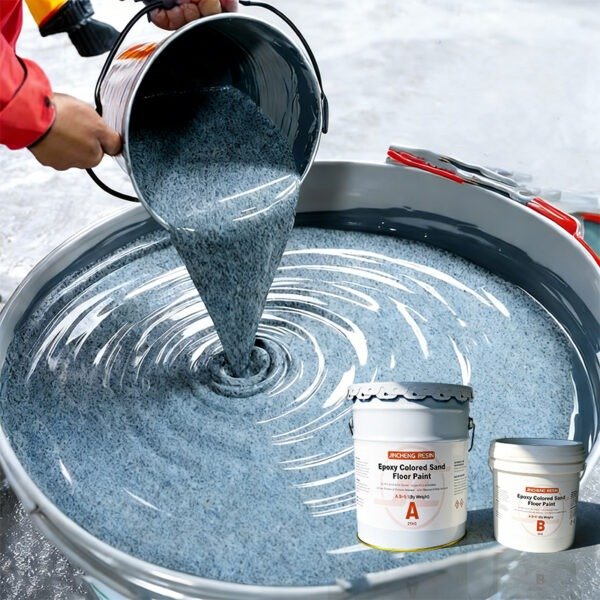
A epoxy colored sand floor coating incorporates colored sand or aggregate into an epoxy-based flooring system.
The aggregate changes the visual appearance and surface texture of the finished floor.
This can make the system particularly attractive for spaces where decorative appearance is important.
Appearance Comparison
Traditional epoxy usually creates a uniform appearance.
It can be available in many colors, but the finished surface generally looks smooth and consistent.
Colored sand systems can provide more depth and variation because multiple aggregate particles create a textured visual effect.
Texture
Texture is another major difference.
Traditional epoxy can be very smooth depending on the system. Colored aggregate introduces additional surface texture.
This can be useful where a more textured finish is desired, although the final slip characteristics depend on the specific aggregate and topcoat.
Durability
Both systems can provide durable surfaces when correctly selected and installed.
However, durability depends on many factors, including:
- Resin formulation
- Coating thickness
- Concrete quality
- Surface preparation
- Traffic
- Impact
- Chemical exposure
- Maintenance
It is therefore not accurate to assume that one system will always outperform the other in every environment.
Cleaning and Maintenance
Smooth epoxy surfaces can be particularly easy to clean because they provide a continuous finish.
Colored sand systems can also be maintained effectively when properly sealed, although their texture may influence cleaning methods.
The recommended cleaning procedure should always match the manufacturer’s specifications.
Design Possibilities
Traditional epoxy provides strong control over base color and finish.
Colored sand offers additional decorative possibilities because different aggregate colors and combinations can create distinctive patterns.
This makes colored sand systems attractive for spaces where flooring contributes significantly to the overall interior design.
Which Is Better for Commercial Areas?
There is no universal answer.
Traditional epoxy may be suitable where a smooth, clean, minimalist appearance is preferred.
Colored sand epoxy may be more appropriate when a decorative, textured finish is desired.
The decision should be based on traffic, maintenance requirements, appearance, environmental exposure, and budget.
Installation Considerations
Both systems require careful surface preparation.
The concrete must be appropriately cleaned and prepared before the coating is applied. Moisture problems and surface defects should be addressed before installation.
Colored aggregate systems may involve additional application steps because the sand must be distributed correctly and sealed with the appropriate resin layer.
Cost Factors
The final cost can vary considerably depending on the floor area, preparation requirements, material thickness, aggregate type, labor, and design complexity.
A simple smooth epoxy system may be less complicated to install, while a decorative aggregate system may require additional materials and labor.
The most appropriate comparison should therefore consider total installed cost rather than material price alone.
Final Verdict
Traditional epoxy and colored sand epoxy systems both have useful applications.
Choose traditional epoxy when you want a smooth, consistent, relatively minimalist finish. Consider colored sand epoxy when you want additional texture, decorative variation, and a more distinctive appearance.
In either case, correct surface preparation and material selection are essential for achieving a long-lasting floor.